
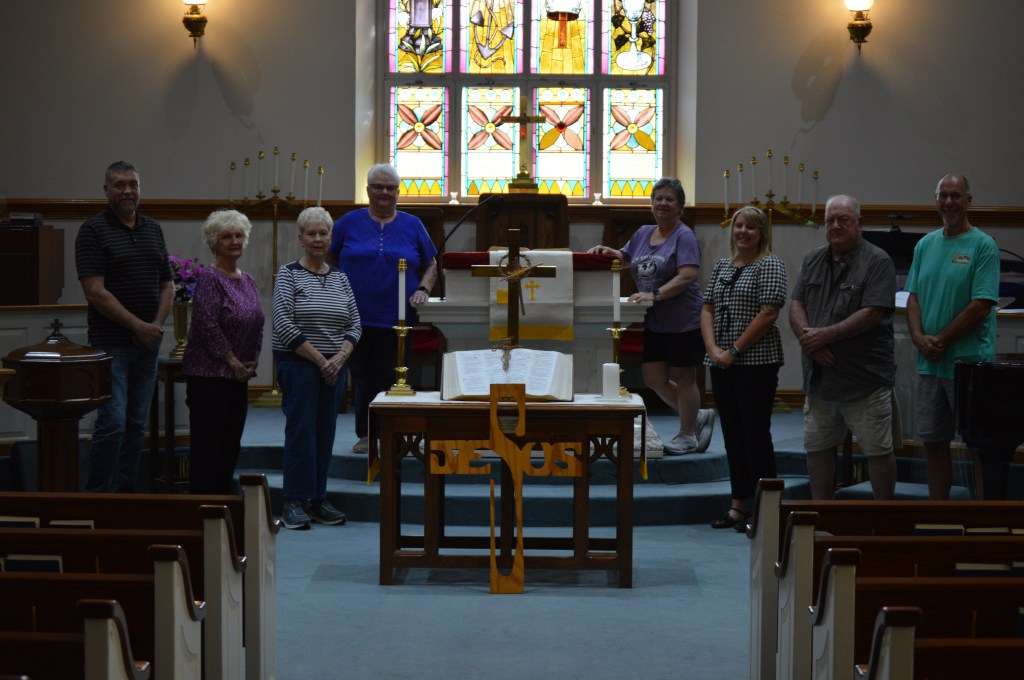
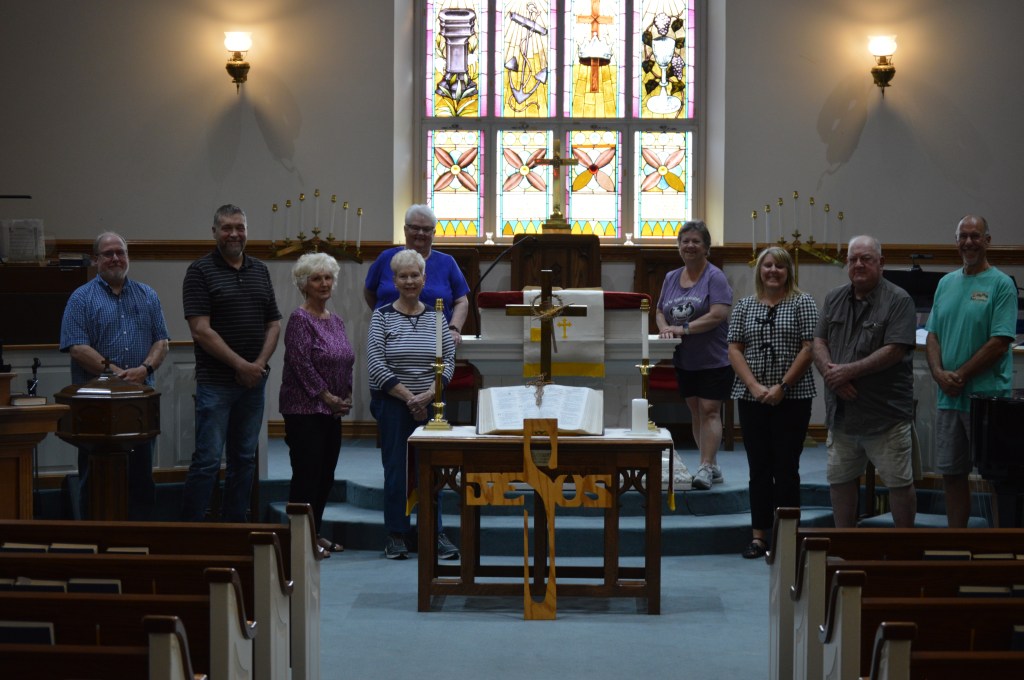
2026 – Highland Session – including our Moderator of Session – Rev. Lon Kuehn of Centre Presbyterian Church, Loysville
The history below comes from “The History of Perry County, Pennsylvania, Including Descriptions of Indians and Pioneer Life from the Time of Earliest Settlement” by Harry Harrison Hain. Of note, the 2 men delegated to explore the possibility of establishing Presbyterian Congregations in what is now Perry County are the same Rev. Charles Beatty and Rev. George Duffield who helped establish the pre-cursor congregations from which Westminster United was formed in Juniata County. Information also taken from PAGENWEB.ORG
Hain’s History can be found in the National Archives HERE
THE EARLY CHURCHES
Blain Presbyterian | Centre Presbyterian | Dick’s Gap Church | Gap Church |
Lebanon Lutheran | Limestone Church | Loysville Reformed | Mt. Pisgah Lutheran |
Mt. Zion Lutheran | Middle Ridge Church | St. Michael’s Lutheran | St. Peter’s Church |
Sherman’s Creek Presbyterian | Shermansdale Presbyterian | Zion Church at Blain
Also see: Churches Between The Mountains & List of Members of the Landisburg Charge
As many as 13 Presbyterian Churches in Perry County (territory) at one time…
1766 – Presbyterian Missionary Rev. Charles Beatty entered Perry County territory via the Alleghany Path, through what is now Sterrett’s Gap. (Hain’s History Pages 232 -235)
Hain’s History – 1766 – Donegal Presbytery formed a committee (2 Ministers = Rev. Robert Cooper & Rev. George Duffield, 3 Elders – Col. Armstrong with William Lyon as alternate, Thomas Wilson, John McKnight) to determine a site or sites for the first Presbyterian Churches in the Shermans Valley. The Elders reconnoitered the area in late June 1766 and the whole group met at George Robinson’s (close to current Centre Church) July 2 – 4, 1766.– The Upper (Blain), Centre, and Dick’s Gap Churches below are the result. (recap from Page 281). Donegal approved these churches on April 14, 1767. All this occurred before the First General Assembly of the then Presbyterian Church in America in 1788. The Limestone Church was recognized by Donegal Presbytery in 1772 after having been built in 1766 or earlier.
BLAIN PRESBYTERIAN CHURCH:
The Blain Presbyterian Church (also known as the Upper Church) was one of the 3 original Presbyterian Churches in this area. A committee reported that a church should be erected at Alexander Morrow’s or James Blaine’s place, for the residents in the upper end of the valley. A graveyard was already in existence (prior to April 1766) at James Blaine’s.
The congregation was organized by c1767; with services most likely held in the resident’s homes. A new church was eventually built near James Blaine’s, near where the ‘Upper Church’ still stands, adjoining the existing graveyard. It was a long, low, log building, standing near the schoolhouse on “Church Hill”. Records indicate that the lot on which the church sat, originally belonged to James Blain.
Membership of the Blain Church eventually declined and by c1920-21, the organization no longer existed. The property of the church was taken over by the Church Hill Cemetery Association.
CENTRE PRESBYTERIAN CHURCH:
Centre Presbyterian Church was one of the first three churches organized in Perry County. On September 9, 1766, Thomas Ross, John Byers, Edward Allet, John Hamilton and Hugh Alexander, in trust for the congregation in Tyrone Twp., took up lands upon which the church stands. The incorporating charter was signed on April 17, 1767, by Gov. William Findley.
The church grounds contained about 7 acres. The parsonage, home of the sexton and the old Centre school were all contained on this land. The adjoining graveyard reportedly has old gravestones dating back to 1766.
A log church was first erected in 1767. Two services were held on Sunday. Tradition says that during the early years, while services were held, men with guns stood guard incase of an attack by the Indians.
In 1793, the log church was replaced by a stone church. Reportedly, some of the logs from the first church, were used when a barn was constructed on the old Wormely farm. A third church was built in 1850 and has been remodeled several times.
LIMESTONE CHURCH:
The Limestone Church was also known as ‘Sam Fisher’s Church’ or the ‘Lower Church’. It’s congregation was also formed quite early, by 1766, but the Presbytery refused to acknowledge this congregation as a separate entity because it was located quite near the Centre Church.
An early Presbyterian church was located at Green Park; on the site of the old burying ground on the farm of John Garlin. Sam Fisher was the original owner of the 36-acre lot where the log church was built.
The church was finally accepted as an organized congregation by the Presbytery on June 24, 1772. Records indicate that the church was abandoned by 1820.
—A Presbyterian Church met in the Temporary Court House in Landisburg at the forming of Perry County prior to the county seat moving to New Bloomfield. Along with the court it shared this space with a Methodist congregation. (Hain’s History of Perry County – Pages 211-212) The Landisburg Presbyterian Church was organized in 1823 after Limestone was abandoned.
DICK’S GAP CHURCH:
Dick’s Gap Church was reportedly the first church erected in this area, though much of it’s early history remains unclear. It was located in Miller Township; 4 miles east of New Bloomfield and 3 miles west of Bailey’s Station. Tradition states that an old Indian trail ran by this church. Built by 1767, Still unchinked & undaubed by 1798 when a mud plaster was finally applied, and no roof yet in 1797 (memories of Mrs. Jane Stewart Black, b. June 4, 1790 mother of Issac Black of Duncannon who attended church with her parents and Grandfather – John Graham, an elder of the church as early as 1773).
It is thought that Dick Gap’s Church was erected to serve the lower end of the portion of Perry County, lying west of the Juniata.
The church was constructed on land which was warranted in 1766, by Nicholas Robinson. The church was 18×20 and was built using pine logs; with worshipper’s reportedly using tree stumps for seats. This church was reportedly still in an uncompleted state by 1798, meaning that the spaces between the logs were not yet filled in and by some accounts, did not have a roof. As early 1793, Dick’s Gap, The Church on Shermans Creek (Shermans Dale), and The Church at the Mouth of the Juniata (Duncannon) all were supplied with pastors by the Presbytery (Hain’s History, Page 296).
It’s exact location is questionable. At one time it’s location was described as being in “an unenclosed graveyard, in which trees of great age are growing near to and even upon graves, and many graves are covered with boulders, seemingly to prevent ravages of wolves.”
H. H. Hain wrote in his book, History of Perry County, Pa., “..consensus of opinion that the old church stood to the east or left of the present Church of God, and somewhat nearer the ridge which runs in the rear of the church.” “There is a gap in the ridge known as Dick’s Hill, which probably accounts for the name Dick’s Gap. It has long since ceased to be known by that name, and is now called Pine Grove..”
There are also various reports that this site included a graveyard; where graves of both traders and Indians are buried. One of the early pioneer’s of this county, Marcus Hulings and his wife, are also reportedly buried here.
This church was reportedly abandoned around 1803; reportedly standing for years as an “abandoned pile of logs.” The Middle Ridge Church took its place.
MIDDLE RIDGE CHURCH:
Middle Ridge Church was first organized in 1803 (it replaced Dick’s Gap Church). A Church building was erected in 1804. Described in Hain’s History (Page 975) as having individual pews with gates hung on forged hinges with brass screws
By an Act of the Pennsylvania Legislature of April 16, 1829, this church was incorporated with two others; the church at the mouth of the Juniata and Sherman’s Creek. The trustees of the Middle Ridge Church were told to sell the building but were unsuccessful. After a period of no use, the building was vandalized. Its doors were torn off, pews were torn out and carried off, even a portion of the roof was taken. Eventually, only the foundation of the old church was left. Abandoned in 1847 (Hain’s History, page 298). Rev. Matthew Patterson installed in Nov. 1831 and service until April 13, 1842 when Presbytery dissolved Middle Ridge and directed the membership to unite with New Bloomfield or Millerstown Churches. (Hain’s History pages 298 & 299). Associate Reformed people (Refomed Presbyterians – The Seeders) worshiped in the building until 1860.
SHERMANSDALE PRESBYTERIAN CHURCH:
The Shermans Dale Presbyterian Church is also known as the Sherman’s Creek Presbyterian Church (and in some records is also referred to as Swisshelm’s). The church is known as the “forerunner” of the Shermans Dale Church. The early history and organization of this church are in part, unclear. The church is first mentioned in the minutes of Presbytery in the spring of 1778, as “Sherman’s Creek” congregation.
The church was located between Fio Forge and Dellville; but the date of construction is not clear. Records from 1801 report that the church was moved, first to Boyd’s (known as the Matlack farm) and in 1802, “to Swisshelm’s” (later known as Adam Zorger’s property). Tradition states that at the graveyard in Zeigler’s field and at Boyd’s fording (Matlack’s), there were built small places of worship.
A log church was built in 1804, at Pine Hill, approximately 100 yards from Sherman’s Creek. This location is about 2-1/2 miles east of the present church. This log church stood until c1843. It was dismantled, and various materials from the old church were used in the construction of the new one. This church is about a half mile north of Shermansdale; the lands were donated by William Smiley.
The Shermans Dale Church was united with the New Bloomfield Church at one point.
At some time around 1867, Buffalo Presbyterian Church, Ickesburg was formed and joined in Ministry with Landisburg Church. In 1895, the Blain, Buffalo, and Landisburg Churches “detached” from Centre Church
—New Bloomfield Presbyterian Church – 1868 County offices were moved to the basement of the Church Building (court was held in the Methodist Church on High St) while a new and expanded Courthouse building was constructed. The original Bloomfield Church was organized in 1831, with the first building completed in 1835. The Second brick building was constructed in 1870. It appears both Middle Ridge Church was weakened to the point of closure as many congregants joined New Bloomfield Church. Presbytery recognized New Bloomfield Church on November 30, 1833. Th857e church joined with the Ickesburg and Landisburg churches to form a charge. After the pastorate of the Rev. John Dickey (1834 – 1854) and service by Supply pastors until 1857, New Bloomfield joined with Petersburg (Duncannon) church and Sherman’s Creek Church to call the Rev. William B. Craig, who served until 1867
1857- 1867, The Rev. William Craig served as pastor to the Shermans Dale Church and the New Bloomfield Church. 1868 Duncannon and Shermans Dale separated from New Bloomfield Church.
From 1885, Shermans Dale (Sherman’s Creek) church was served by New Bloomfield’s ministers.
Millerstown Church – organized in a bar room, held services there. First sermon, 1806 by the Rev. John Hutchinson of Mifflintown in the Cochran Tavern (now the VFW) though the folks attending belonged to Middle Ridge or Lost Creek (McAlisterville) churches. The Congregation was regularly organized in 1818 by the Rev. N. R. Snowden in a school building located in the northeast corner of the Millerstown Cemetery plot. Likely erected in 1808 or thereabouts. This building served as both school and church. Rev. Snowden, there 2 years, also served the congregations in Liverpool, and one in New Buffalo, part of Huntingdon Presbytery, until 1845. The area along the Susquehanna River was moved from Huntingdon Presbytery to Carlisle Presbytery in 1829. These two churches ceased to exist in 1830.
Thomas Cochran donated the land the Stone Building we know as the Millerstown Church sits upon and was constructed during the pastorate of Rev. Britton E. Collins who was called in 1829. Dedicated in May, 1832. May 14, 1842, 31 of 33 new members of Middle Ridge church transferred to Millerstown Church. In total, 50 Middle Ridge congregants eventually came to Millerstown. New Bloomfield received some, and the Newport Church also received some. Millerstown Church was joined to Centre and Buffalo (Ickesburg) Churches by Presbytery in 1851 (though Millerstown seems to have filled its own pulpit with the Duncannon Minister). Later December 1856, the three churches called Rev. John B. Strain.
1875 saw renovations to the building and the addition of the Sunday School room, and the entrance relocated to the east side of the building. Manse purchased in 1877 at the time of incorporation. In 1887 further renovations were accomplished, including moving entrance to corner and adding entrance on High St, rearranging of the interior to allow lecture room to be used in conjunction with the auditorium (Sanctuary), and the memorial windows, including what we know as The Governor’s Window (though Beaver was not yet Governor)
Church at the Mouth of the Juniata (forerunner of Duncannon Church) records as early as 1804, was once blown down in a wind storm.
Wright’s Church – (Hain’s History, Page 965) – replaced a school house on the same site, Millerstown pastors served the church. Named for Charles Wright Sr., who bequeathed an acre of land adjoining the church ground for a cemetery. Built in 1890, dedicated May 24, 1891. The school house had been purchased from the township by Mr. Wright, and various congregations (Lutherans, Evangelicals, Methodists, and Presbyterians) used the school house at different times. This church becomes Perry Valley Church and is moved across the road to sit beside the cemetery.
NEWPORT UNION CHURCH – (Hain’s History page 1033) Lutheran, Reformed, and Presbyterians residing about Newport held a conference in 1846 and agreed to erect a joint church. That plot of land on the corner of 2nd and Walnut streets was deeded on May 1st 1846 by John and Barbara Wiley to Andrew Maxwell, John Loy, and John Fickes. The cornerstone was laid on May 12, 1846 and the building dedicated on May 23, 1847. The Reformed congregation sold their 1/3 to the Lutherans and Presbyterians in 1868, and in 1877 the Presbyterians purchased the Lutherans’ half. This was Newport’s first church. The Presbyterian congregation was organized on April 18, 1863 by petition to the Presbytery of Carlisle with 15 members. In 1885 an addition was built and the whole church remodeled. It was re-dedicated on December 13, 1885. The Sunday School dates from 1873. The original building may have been replaced with the building on the site today. This became Newport Presbyterian Church and in 1960 merged with the New Bloomfield and formed 1st United Presbyterian Church.
REV. Focht’s “Churches Between the Mountains”
Rev. W.H. Logan – Pastor at Millerstown Church – Historical Articles
Plaque in Bloomfield church honoring martyred missionaries – husband was former member – In Loving Memory of Rev. and Mrs. John Rodgers Peale who were martyred at Lein Chow, China, October 28, 1905 “I am ready not to be bound only, but also to die at Jerusalem for the name of the Lord Jesus.”
1868 – Rev. William P. Cochran, born in Millerstown in 1803, became pastor of Millerstown Church before returning to Missouri. During his short time in Millerstown, he organized a congregation in Newport.
A short lived Presbyterian and German Reformed Church existed in Liverpool (organized in 1818 by Rev. Nathaniel K. Snowden – pastor till 1820, vacant until 1828 when Rev. James F. Irvine was installed). They both used the Union Church in Bucks Valley. A Reformed congregation did meet at Barner’s Church at this same time.
Conclusion – Highland United can trace its beginnings back to Dick’s Gap (what we might now call Dix Hill) church in current Pine Grove in 1766 to Middle Ridge Church in 1803 to The Millerstown (1806) and New Bloomfield (1831) Churches, and then 1st United in Newport (1846)… and Perry Valley (1890). The JVSM pulls this heritage along with it.
The video presentation below picks up the formation of Highland United beginning with the New Bloomfield, Millerstown, and Newport Churches.
1st United in Newport called its Newsletter The Lamplighter – here you’ll find some call backs to 1st United Newport:
Session prior to 1972:
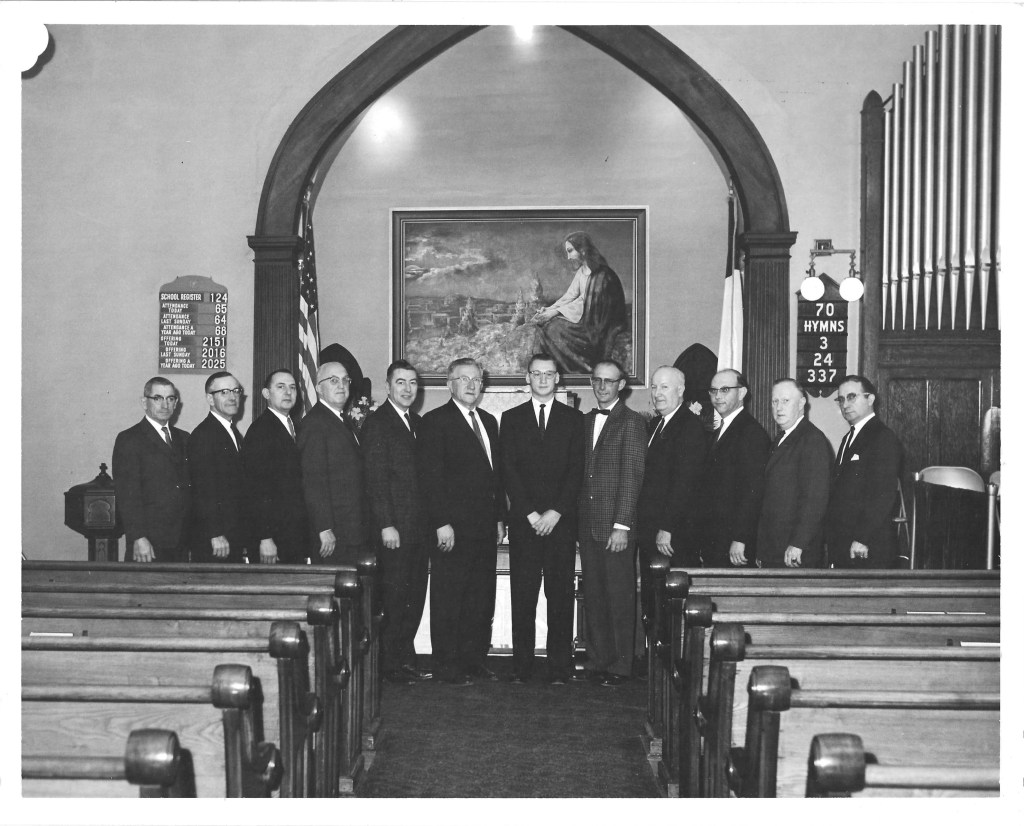
Two copies of The Lamplighter from 1970 and 1976
 The Juniata Valley Shared Ministry